Science-Based Targets & Net Zero
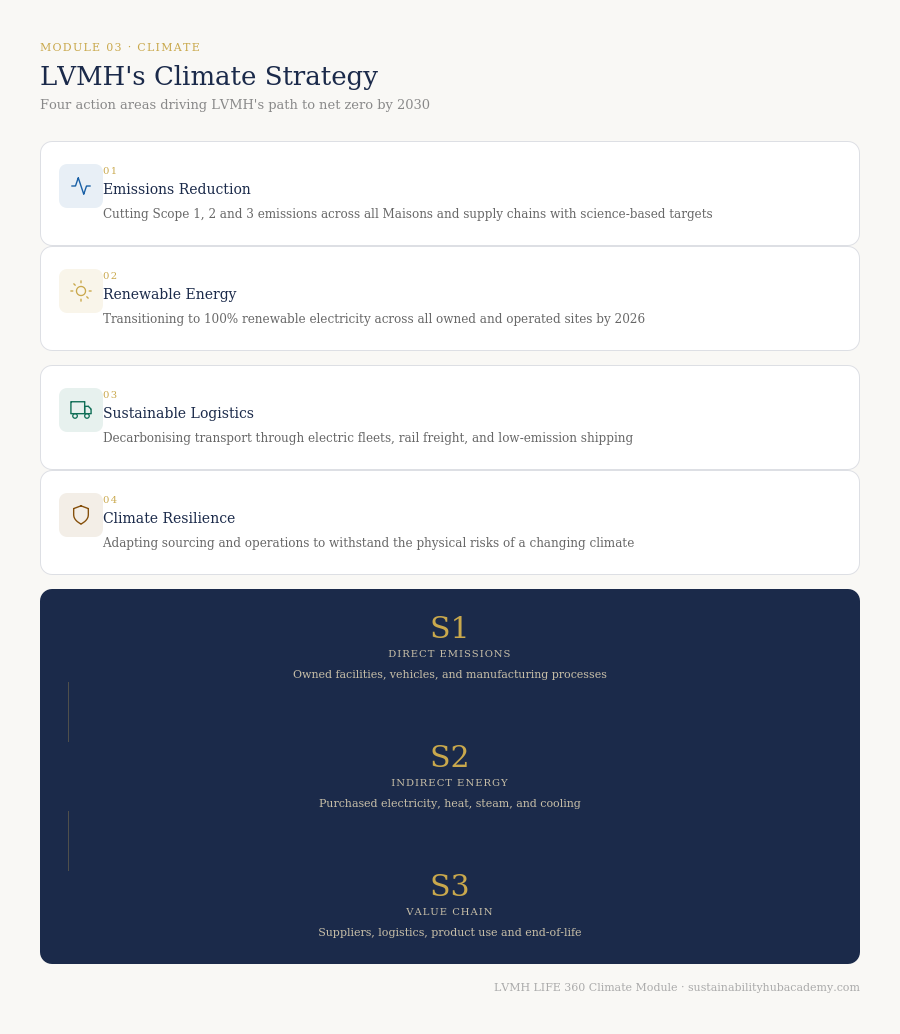
LVMH has committed to science-based climate targets aligned with the Paris Agreement goal of limiting global warming to 1.5°C above pre-industrial levels. This means reducing greenhouse gas emissions across all three scopes at a pace and scale consistent with climate science.
Understanding Emission Scopes:
| SCOPE | WHAT IT COVERS | LVMH EXAMPLES |
| Scope 1 | Direct emissions from owned or controlled sources | Fuel combustion in LVMH factories, company vehicles, heating systems |
| Scope 2 | Indirect emissions from purchased electricity, steam, heat or cooling | Electricity used in LVMH boutiques, offices, and production facilities worldwide |
| Scope 3 | All other indirect emissions in the value chain — the largest and most complex category | Raw material production, supplier manufacturing, product transport, customer use, and end-of-life disposal |
LVMH’s 2030 Climate Commitments
- Reduce absolute Scope 1 and 2 emissions by 50% by 2030 versus 2019 baseline
- Achieve 100% renewable electricity across all LVMH operations by 2026
- Reduce Scope 3 emissions intensity by 55% by 2030
- Engage top 300 suppliers on science-based emissions reduction targets
- Achieve carbon neutrality across own operations by 2026
Climate Action Across the Maisons
The following examples show how LVMH Maisons are translating the Climate pillar into concrete action.
LVMH — RE100 Renewable Energy Commitment
LVMH has joined RE100, the global corporate renewable energy initiative, committing to sourcing 100% of its electricity from renewable sources by 2026. This is being achieved through a combination of on-site solar installations, Power Purchase Agreements (PPAs) with renewable energy producers, and renewable energy certificates across all operating regions.
Moët & Chandon — Solar Energy in Champagne
Moët & Chandon has installed extensive solar panel arrays across its Champagne production facilities and vineyard buildings, generating a significant proportion of the energy required for its winemaking operations on-site. The initiative forms part of a broader commitment to decarbonise the energy-intensive processes of sparkling wine production.
Louis Vuitton — Green Logistics Programme
Louis Vuitton has launched a comprehensive green logistics programme targeting the emissions generated by transporting its products from ateliers to retail locations worldwide. Initiatives include shifting from air freight to sea and rail for non-urgent shipments, optimising delivery routes, and trialling electric and hydrogen vehicles for last-mile delivery in urban markets.
Hennessy — Carbon Sequestration in Vineyards
As part of its regenerative viticulture programme, Hennessy is actively measuring and increasing carbon sequestration in its vineyard soils. Healthy, biologically active soils absorb and store significant quantities of carbon dioxide — meaning that regenerating the soil is simultaneously a biodiversity and climate action. Hennessy is working with scientific partners to quantify the carbon stored in its Cognac landscape.
Sephora — Energy Efficiency in Retail
Sephora has committed to reducing energy consumption across its global retail network through LED lighting upgrades, smart HVAC systems, and energy management platforms that monitor consumption in real time. These measures target Scope 2 emissions from electricity use — the most controllable source of emissions for a retail-intensive business.